
Web developer rates: how to list yours so clients stop asking
You post a site you built. Three people message "how much for a website?" Two go quiet at the number. The third wanted a logo.
A public rate card fixes most of that. Clients see what you build and roughly what it costs, and the ones who write already fit.
- List packages, not just an hourly rate.
- Say what each package includes, how long it takes and what it does not cover.
- Show starting prices if your builds vary. That is enough to filter.
- Ask for a deposit before you start.
- Keep platform costs (Shopify, Squarespace, apps, domain) separate from your fee.
Why a public rate card wins clients
- Fewer "how much?" messages. The answer is already on your page.
- Better leads. A client with a smaller budget sees your starting price before anyone books a call.
- Faster yes. When a package matches what they need, the client asks to book, not to negotiate.

If you have never written one, start with how to make a rate card for any service.
What to put on it
Packages
Most web work falls into a handful of jobs. Name them the way clients search for them:
- Landing page. One page, one goal: sign-ups, bookings, a launch.
- Shopify store setup. Theme, products, payments, shipping, launch.
- Squarespace site. A small business or portfolio site on a template the client can edit.
- Custom build. Your own code, for things a template cannot do.
- Maintenance retainer. Updates, fixes, backups and small changes each month.
Three to six packages is plenty. Our guide on service packages and tiers covers how to shape them.
Hourly or fixed
- Fixed price for work you can define: a page count, a store with up to 50 products.
- Hourly for work you cannot see the end of: fixes on someone else's code, a stack you have not used.
- Both is common: packages up front, an hourly rate for changes outside the brief.
What is included
For each package, list it plainly:
- number of pages or products;
- rounds of changes;
- who writes the copy and supplies the photos;
- training for the client;
- support after launch, and for how long.
Turnaround and deposit
Give a time for each package ("2 to 3 weeks from the deposit") and one line of terms: "50% to book, 50% before launch." Our guide on how to ask for a deposit has the words to use.
Example prices
| Package | Price | Turnaround |
|---|---|---|
| Landing page | from USD 800 | 1 to 2 weeks |
| Squarespace site, up to 5 pages | from USD 1,200 | 2 to 3 weeks |
| Shopify store setup, up to 50 products | from USD 1,500 | 2 to 4 weeks |
| Custom build | from USD 5,000, quoted | 6 weeks and up |
| Maintenance retainer | USD 150–500 a month | Ongoing |
| Changes outside the brief | USD 60 an hour | As booked |
Example prices show in USD, or in your local currency in a few countries. On your Piku page, each Rate shows in the currency you set, the same for every visitor, so list them in the currency your clients pay in.
Keep platform costs separate. The client pays the platform directly. Checked on 31 October 2026 on each company's own pricing page:
- Shopify lists its Basic plan at $19 a month billed yearly, or $27 billed monthly.
- Squarespace lists its plans and prices on its pricing page; send clients there rather than quoting a number that can change.
Add a line under your table: "Platform plan, apps, theme and domain are paid by the client."
Where Shopify Partners and Squarespace Circle fit
Both are partner programs, not places that set your price. Checked on 31 October 2026, on their own sites:
- Shopify Partner Program. Free to join. Partners build stores, themes and apps for merchants, get test stores, and can earn a monthly revenue share for clients they refer.
- Squarespace Circle. Free to join, for freelancers and agencies who build on Squarespace. Tiers bring discounts on client subscriptions, longer trials and referral commissions.
- Squarespace Marketplace. Where clients hire independent Squarespace Experts. Experts are Circle partners invited based on demand. To be considered, you must build eight Squarespace sites in a year.
Join the ones that match your stack. You still need your own rate card for clients who find you elsewhere.
When a client needs a shop: BareConnect
Disclosure: BareConnect is built by the same team as Piku. Read with that in mind.
BareConnect is a website and store builder: storefront, your client's domain, products, services and bookings, in-person sales, and a mobile app. Checked on 31 October 2026:
- it has a free Starter plan and paid plans, listed from $8.10 a month billed yearly;
- it has a partner program for agencies that build client stores, paying up to 30% of each referred merchant's subscription for as long as they stay.
Honest scope: it suits shops and service businesses that want a store, bookings and in-person sales in one place. If a client is set on Shopify or Squarespace, use those. If you add it, add it as a package: "BareConnect store setup, from USD 1,000".
How a Piku page holds it all
A Piku page is one link for your work:
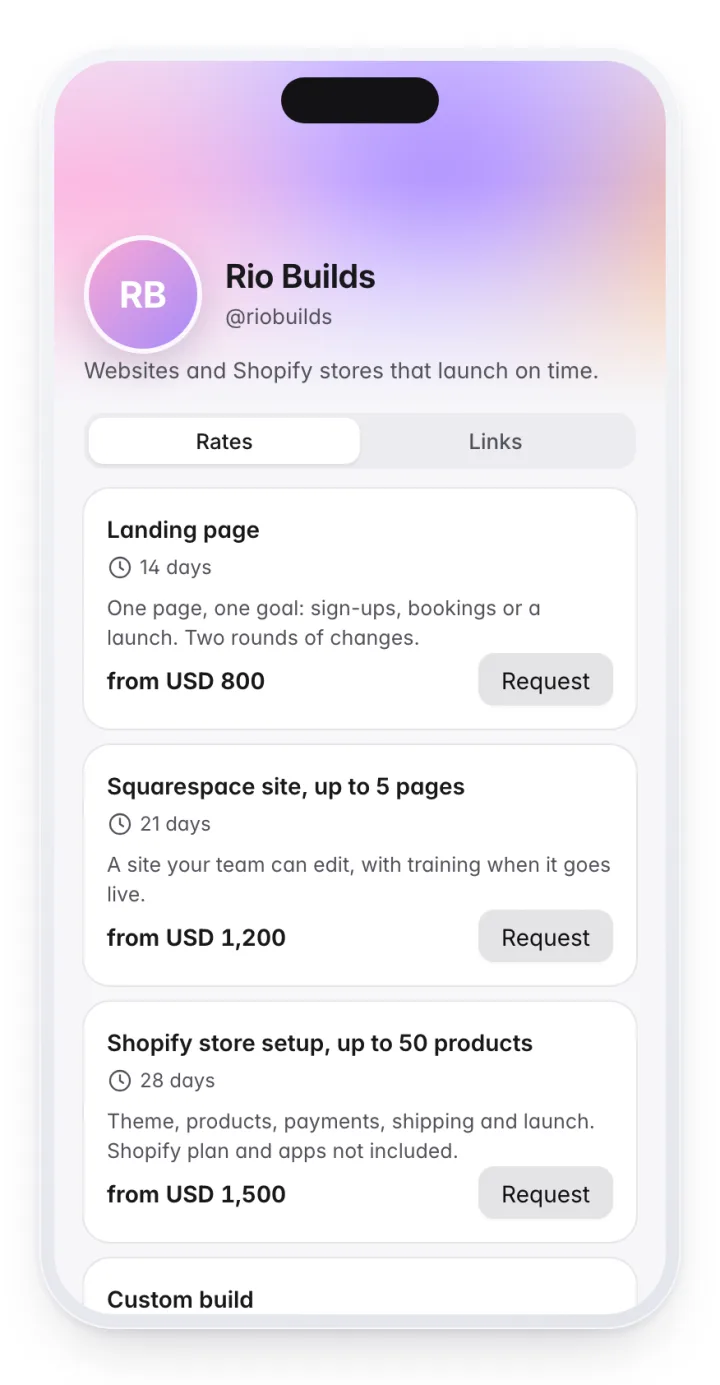
- Rate Card. Each package is a Rate: a fixed price, a starting price or a range.
- Requests and quotes. A client asks on a Rate. You send a quote with the scope. They accept from a link. Our guide on how to write a quote covers what goes in it.
- Deposits. Add a deposit to the quote. Each part becomes its own invoice.
- Invoices and receipts. Each invoice has a pay link and a PDF. Clients pay by card or mobile money, and the receipt sends itself.
Piku keeps 2% of each paid invoice, never more than $25. Payment provider fees are separate.
Questions
How much should a web developer charge?
It depends on the build, your market and your experience, so there is no single number. Price by package where you can: a landing page, a store setup, a custom build. Keep an hourly rate for changes and work outside the brief.
Should a web developer charge hourly or a fixed price?
Fixed prices for work you can define, like a five-page site or a store setup. Hourly for open-ended work, like fixes on someone else's code. Many developers show both: packages first, an hourly rate for extras.
Should I show my rates publicly?
Starting prices are enough. "Shopify store setup, from $1,500" tells a client whether you fit their budget before they write, so the messages you get are from people ready to talk.
How much deposit should a web developer ask for?
Many ask for 50% to book the start date and 50% before launch. On long builds, split the balance into stages tied to milestones, such as design sign-off and launch.
Do clients pay for Shopify or Squarespace on top of my fee?
Yes. The platform plan, apps, themes and domain are the client's running costs. Say so on your rate card, so nobody thinks your fee includes them.